

Theresa pulled up to the 2 p.m. showing fifteen minutes early.
She always did. Fifteen minutes was the buffer she’d built into her calendar a decade ago, when she realized that being early was the difference between being prepared and being seen as scattered. You walked into a house ten minutes ahead of the buyers, you turned on the lights, you opened the blinds, you ran a finger along the kitchen counter to check for dust, and you stood by the door looking calm and ready when the buyers arrived.
She had done this hundreds of times.
Today, though, she pulled up, turned off the car, and just sat there for a second.
Because she had eaten — let’s see — half a banana at 7:15 a.m., a sip of her husband’s protein shake she had grabbed on the way out the door, and a handful of almonds from the bag in her glovebox that had been opened on Tuesday and was now Friday.
She had not eaten lunch.
She had not eaten lunch yesterday either.
She had not eaten lunch the day before that, technically, because the thing she had eaten at her desk between back-to-back calls had been a granola bar and a coffee, and she’d been generous in counting it.
She was 52 years old. She was a top producer. She was in a black blazer over a soft tee, looking professional and prepared and exactly the woman the buyers were expecting.
And she had not properly fed herself in three days.
She got out of the car.
She walked to the house.
She did the showing.
Halfway through the tour — at the part where you walk the buyers through the primary bedroom and let them imagine their own life in it — Theresa’s hands started shaking.
Not visibly. Not dramatically. Just a fine, persistent tremor that she noticed when she was gesturing toward the walk-in closet and her fingers wouldn’t quite hold steady.
Her brain was foggy. She could feel it. The kind of fog where you reach for a word and the word doesn’t come, and you have to talk around the word until it comes back. She’d called the kitchen the cooking room about ten minutes earlier, and the buyer had given her a small, polite look that she’d had to pretend she hadn’t seen.
The room was warm. She felt cold. Her hands were shaking.
And inside her head, a voice she rarely listened to said — quietly, but clearly:
You did this to yourself again.
She finished the showing. She got the buyers out the door. She told them she’d send the comps over by evening. She turned off the lights. She locked the door behind her. She got back to her car.
She sat down in the driver’s seat.
She did not start the engine.
She just sat there, hands trembling slightly on the steering wheel, brain fog drifting over everything she was trying to think about, and she let herself notice — fully, for the first time in months — that she had been doing this for a long time.
Skipping lunch.
Skipping breakfast more often than she liked to admit.
Living on coffee until 3 p.m. and then eating something she couldn’t quite call a meal at 4.
Telling herself she was busy. Telling herself she was getting things done. Telling herself she’d eat after this one more thing.
And the one more thing always came.
I want to talk to you about this, because I don’t think it’s about lunch.
It’s about lunch.
But it’s also about every small body request you have learned to override in service of how much you produce in a day.
It is about needing to use the bathroom and not stopping for it because the client is on the phone. It is about needing to drink water and not doing it because the buyers are about to pull up. It is about being hungry and answering the hunger with another coffee because you have a 3 p.m. and there’s no time.
It is about a body that has been categorized as an interruption to the actual work — for so long, by so many small daily decisions, that you no longer hear her requests as needs.
You hear them as inconveniences.
And the inconveniences keep getting overridden, because there’s always another appointment, another client, another deal, another one more thing.
Until, on an ordinary Friday afternoon, at an ordinary showing, in an ordinary primary bedroom — your hands start shaking and you can’t remember the word for kitchen.
That’s not a personal failing.
That’s a body that has stopped agreeing.
Here is the part I want to say carefully.
This industry — the one you and I are in — does not treat your body as a person.
It treats your body as equipment. Something that holds you up so you can do the actual work. Something that needs to keep functioning so the showings can happen, the listings can get signed, the closings can close, the pipeline can fill.
Your body is not invited to the calendar conversation.
Your body is not consulted when you commit to a 7 a.m. broker open and a 6 p.m. signing on the same day. Your body is not asked whether she has the capacity for back-to-back showings. Your body is not given lunch breaks — she’s given whatever you can grab between things, if you remember.
This is not a personal time-management failure on your part.
This is the baseline assumption of an industry that was built on the premise that the agent’s body is infinite resource. That she will keep producing. That if she gets tired, she just needs more caffeine, more discipline, more grit.
You have been operating inside that assumption for years. Maybe decades.
And your body is finally — for reasons you can probably feel in your nervous system right now — refusing to keep agreeing to it.
The shaking hands. The brain fog. The 3 a.m. wake-ups. The strange tearfulness on a Wednesday afternoon for no reason. The way the morning showings feel harder than they used to. The way you can’t quite recover from one demanding week the way you used to.
These are not failures of will.
These are the body, saying: I cannot keep being treated as equipment. I am a person. I am part of this. And I am no longer going to let you override me at lunch.
Theresa sat in her car for a long time.
She didn’t text anyone. She didn’t open her laptop. She didn’t pull up her schedule to figure out how to fix it.
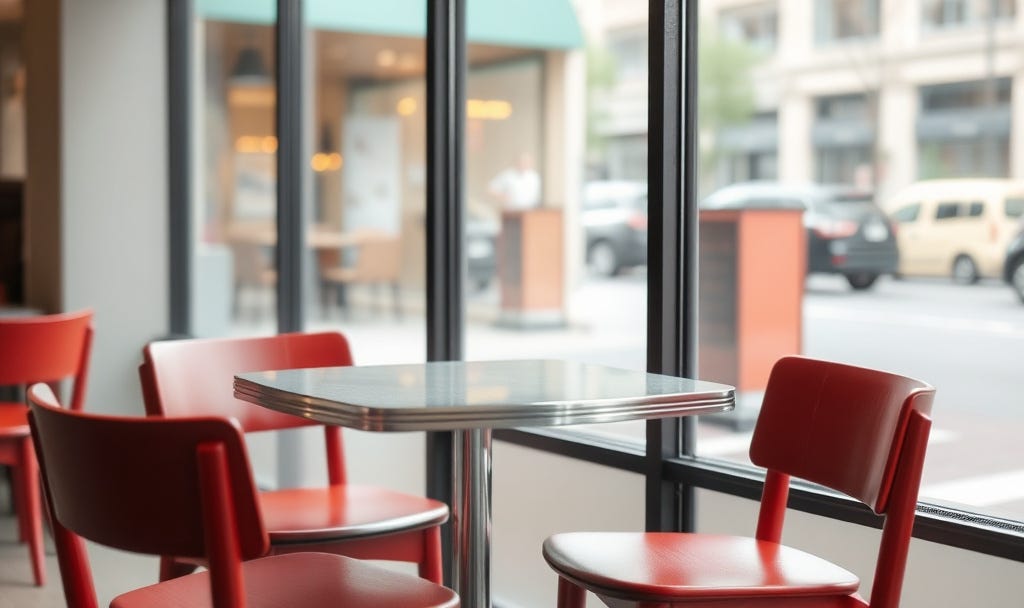
She drove to a small café three blocks away, the one she’d been driving past for months without ever stopping at, and she went inside, and she ordered a real lunch.
A sandwich. A bowl of soup. Water with lemon. She sat at a table by the window. She ate slowly. She didn’t check her phone.
This was not a dramatic moment of transformation.
She did not have an epiphany.
She did not decide to overhaul her business or quit real estate or radically restructure her week.
She just — for the first time in months — let her body finish a meal in a place that wasn’t her car or her desk.
When she got home that night, she sat on the edge of her bed for a minute before she got up to make dinner. And she felt something she hadn’t felt in a long time.
Steadiness.
Not joy. Not bliss. Not breakthrough.
Just steadiness.
The body that had been shaking three hours earlier was no longer shaking. The brain that had been searching for the word kitchen was clear. The version of her that had walked into the 2 p.m. showing running on a handful of almonds and a sip of protein shake was not the version of her that was now sitting on the edge of the bed.
And she thought, quietly:
This is what I’ve been missing.
Not because the lunch was special.
Because the lunch was answered.
I want you to hear me.
You cannot keep performing this work in a body you are not feeding.
Not because the lunch is the answer to everything — it isn’t. There are bigger structural questions about how you’ve built your business, how you’ve structured your week, what you’ve been overriding for years.
But the lunch is one place the override has been happening.
And the override has been the loudest, most daily, most ordinary place where your body has been saying please, see me as a person.
You don’t have to overhaul your business. You don’t have to quit anything. You don’t have to make a grand structural change this week.
You can just stop skipping lunch.
You can sit in a café for thirty minutes between showings.
You can eat a real meal at a table that isn’t your car.
You can let your body finish a meal somewhere that isn’t in transit to the next thing.
That’s where it starts.
Not in the strategy. Not in the calendar overhaul. Not in the dramatic reinvention.
In a sandwich.
At 2:45 p.m.
Eaten slowly.
In a body you have finally decided to feed.
You’re not behind. You’re not too late. You’re not done.
You’re just starting to feed the woman who has been carrying you through every single showing of every single year of this career.
I got you. ❤
— Andrea